Sd.Kfz. 251/1
mittlerer Schützenpanzerwagen
Overview

Sd.Kfz. 251 Ausf. D
Restored Sd.Kfz. 251 Ausf. D nicknamed "Rosi" seen in the woods in 2008.
Source: Mariusz Rzepkowski -
© CC BY-SA 3.0
Nazi Germany - Hanomag
Nazi Germany - Adlerwerke
Nazi Germany - Horch
Nazi Germany - Skoda
mittlerer Gepanzerter Mannschaftstransportwagen
"medium armored troop transport"
mittlerer Schützenpanzerwagen (SPW)
"medium infantry armored vehicle"
Description
Introduction
The Sd.Kfz. 251 is a World War 2 era armored personnel carrier of Nazi German origin. It is an iconic vehicle of World War 2 and the first use of a dedicated armored personnel carrier design using in a mechanized assault doctrine. This halftrack was in widespread use during the war and served as the basis for many specialized variants. Many variants were produced, of which the Sd.Kfz. 251/1 is the baseline armored personnel carrier.
Design
The Sd.Kfz. 251 is based on the Sd.Kfz. 3-ton halftrack that started production one year prior. The chassis and engine of the Sd.Kfz. 11 were retained, on top of which an angled monocoque armored superstructure was built. This had the engine in the front protected by armor, a driver and passenger seated side by side with roof cover and a large open roof rear troop compartment with rear access doors. Stowage bins are located on either side above the tracks.
Firepower
The Sd.Kfz. 251 is armed with a 7.92mm MG-34 or MG-42 belt fed machine gun at the front of the open roof compartment. It is manned by a single operator standing in the passenger compartment. A V-shaped gun shield provides a degree of protection. At the rear of the passenger compartment a second mounting arm for a MG-34 or MG-42 machine gun is fitted. This allows the infantry section to use their machine gun from the vehicle. The rear mounting point does not have a gun shield, but allows better firing angles all around and against aircraft.
The baseline vehicle also served as the chassis for many specialist fire support vehicles. These include a 75mm assault gun, flame thrower vehicle, 28mm, 37mm and 75mm anti-tank guns, and several 15mm or 20mm anti-aircraft guns versions. These are described in separate articles.
Mobility
The halftrack chassis provides a good mobility for World War 2 era vehicles. Compared to trucks the road speed is much reduced, but the mobility in the field is much improved and a necessity to support tank formations. The interleaved roadwheels distribute weight well and the oiled tracks have low friction for metal tracks. The difficulty lies in maintenance. The engine and drivetrain components are difficult to reach. The interleaved roadwheels are prone to clogged dirt and snow. The 100 hp engine allows for a maximum speed of 52 km/h. An average road speed of 30 km/h was more realistic. Minor steering adjustments are done by the front wheels, while a more serious change in direction engages the friction brakes on the final drives of the tracks.
Protection
The Sd.Kfz. 251 is the first armored personnel carrier by design and doctrine. Protection from small arms fire is good. The Sd.Kfz. 251 uses face hardened steel armor in an angular construction to maximize efficacy. The open roof passenger compartment is vulnerable to fire from above and hand grenades tossed inside. The armor cannot protect the occupants from anything beyond rifle fire. Even small caliber anti-tank guns can successfully engage the Sd.Kfz. 251.
Users
The Sd.Kfz. 251 was used extensively by Nazi Germany during World War 2. Hardly any were available during the invation of Poland and small numbers were used in the invasion of France. Production numbers only started to become significant in the second half of the war. As such the Sd.Kfz. 251 is mostly associated with the fighting on the Eastern front, and later also in the Western front. After the war small numbers were used by some Eastern European nations before transitioning to Soviet vehicles. In Czechoslovakia the OT-810 was produced, which is derived from the Sd.Kfz.251, but differs in various aspects.
Variants
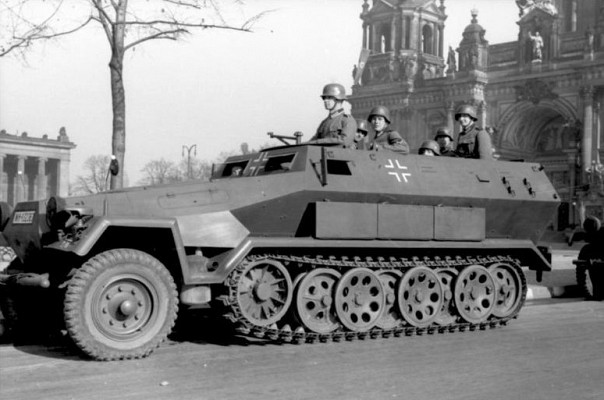
Sd.Kfz. 251 Ausf. A
The Ausführung A is the first prodcution model of the Sd.Kfz. 251. In 1939 these were produced both as armored (232 pcs) and "Ungepanzerte" with regular mild steel (305 pcs) due to lack of armor grade steel. The Ausf. A is recognizable by the vision ports in the side of the crew compartment.
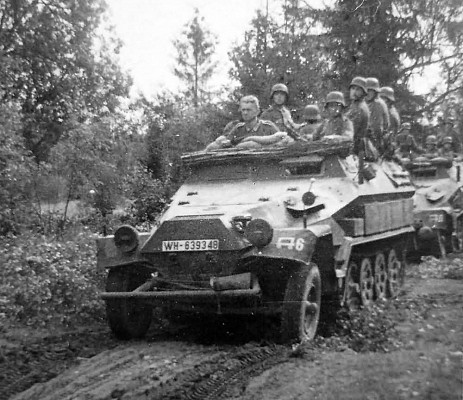
Sd.Kfz. 251 Ausf. B
The Ausführung B is a production model with improved automotive components. It is also the version that introduces the HL 42 TURKM engine used in all subsequent models. Externally the Ausf. B is similar to the A, but lacks the vision blocks in the crew compartment and introduced the V-shaped shield for the forward machine gun. Internally the B has a rearranged interior layout.
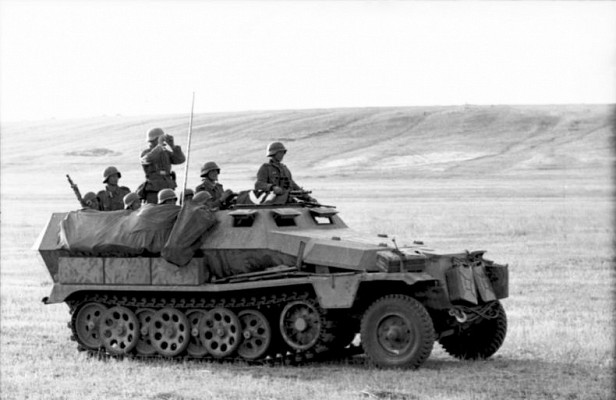
Sd.Kfz. 251 Ausf. C
The Ausf. C was optimized for series production and produced larger numbers compared to the A and B models. It is most easily recognized by the new sloped hexagonal armored plate on the nose and lack of front bumper, while still retaining the bulged rear doors. Covered air intakes are located on either side of the bonnet. The stowage boxes are moved to the rear of the fender. Internally the benches are given backrests.
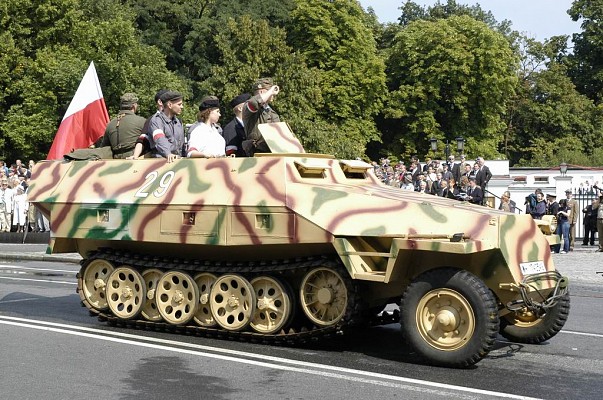
Sd.Kfz. 251 Ausf. D
The Ausf. D was the final iteration and was produced in the largest numbers. With over 10.600 produces this model represents two-third of all Sd.Kfz. 251 produced. The Ausf. D introduced a sloped rear section with two flat doors. The side stowage bins are now flush instead of located on top of the rear fender.
Details
Media

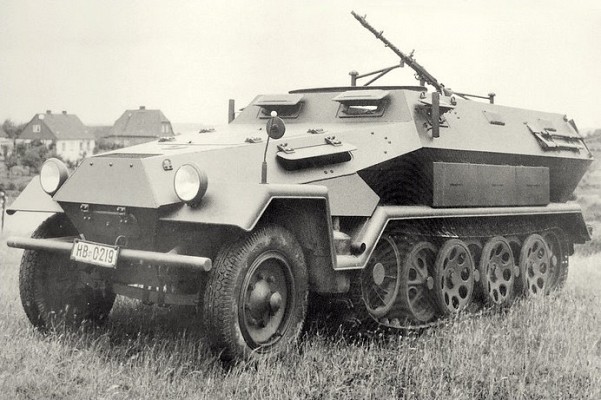
Sd.Kfz. 251/1 Ausf. A
A Sd.Kfz. 251/1 Ausf. A seen in the field.
Source: Unknown author
Copyright: Copyright lies with original owner
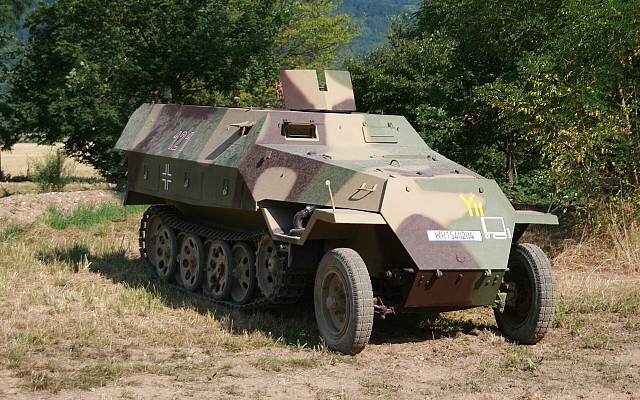

Sd.Kfz. 251 Ausf. D
Forward view of a restored Sd.Kfz. 251 Ausf. D in the field in 2015.
Source: Glunggenbauer
Copyright: CC BY-SA 4.0
Armament
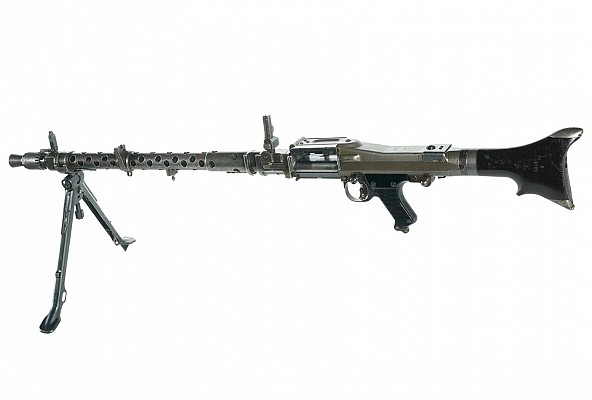
MG34
Early models were armed with the 7.92mm MG34 machine gun. The section's MG34 could be mounted on the rear mounting point.

MG42
Most Sd.Kfz. 251 were armed with the 7.92mm MG42 machine gun with a V-shaped gun shield.
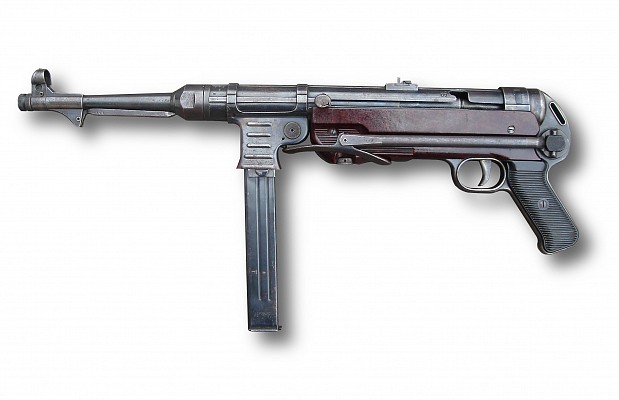
MP 40
The MP 38 and MP 40 sub machine guns feature a bakelite strip under the barrel. This is intended to rest the barrel on the sides of the open roof and allow for fire from the vehicle while moving.
Variants based on the Sd.Kfz. 251 chassis
Note: incomplete list
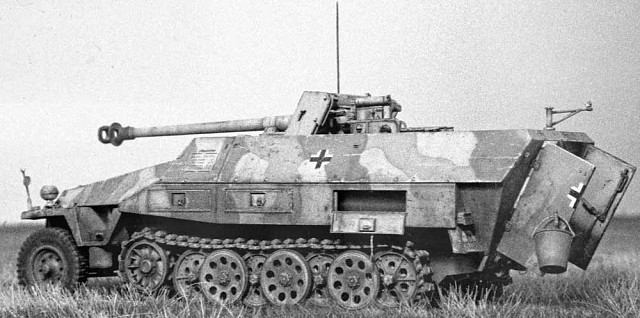
Sd.Kfz. 251/22
Late war tank destroyer variant using a 75mm PaK-40 anti-tank gun. Produced only on the Ausf. D model as newly built vehicles. Also supplied as conversion kits for field workshops.