S-300V
NATO: SA-12 Gladiator / Giant
Overview

S-300V
Several launch and fire control radar vehicles of the S-300V surface to air missile system.
Source: www.ausairpower.net -
© Copyright lies with original owner
1988 (with 9M82 missiles)
1980 - 1983 (Soviet state trials)
Soviet Union - NIEMI (later NPO Antey)
Soviet Union - OKB-8 Novator
SA-12B Giant (NATO reporting name)
9K81 (GRAU index)
Russia
Ukraine
Belarus
Description
Introduction
The S-300V is a late Cold War era surface to air missile system of Soviet origin. It is a complex and capable system intended to protect army formations in the field from aerial threats and inbound cruise missiles and short range ballistic missiles. There are two NATO reporting names: SA-12A Gladiator for the smaller 9M83 missile and SA-12B Giant for the larger 9M82 missile. The GRAU index for the entire system is 9K81. The name S-300V refers to Vojska ("army") and ended up as a completely different design than the S-300P series developed for the air defense forces.
Design
The S-300V operates at the divisional level with a command post and specialized long range radars. Four batteries consist of an engagement radar and multiple launch vehicles with fire control radars and reloading cranes. The S-300V was first operational with only the smaller 9M83 missile. Dedicated cruise and ballistic missile defense capability was added years later. Unlike most Soviet SAM systems there is no naval counterpart to the S-300V.
Fire control
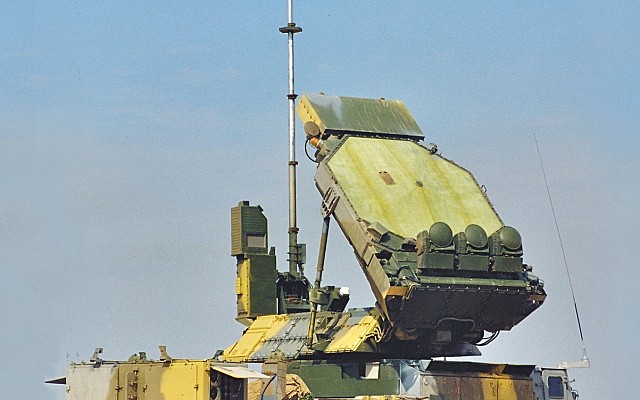
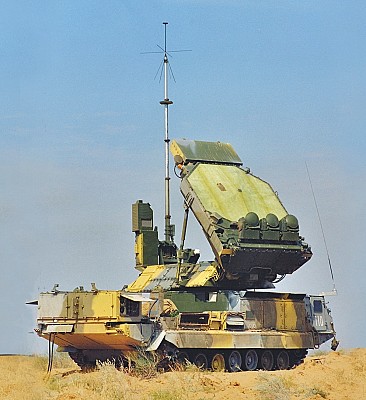
At the battery level the 9S32 radar vehicle target tracking and hands them off to launch vehicles with fire control radar. With six of these per battery multiple threats can be engaged simultaneously. Throughout the engagement there is communication between the 9S32 and the fire control radars. At the divisional level the 9S15 radar provides all around long range surveillance. This is done by scanning a 45 degree sector out to 240 km for 12 seconds before moving on to another sector. The 9S19 radar is focused on missile defense. It calculates ballistic missile or cruise missile flight paths out to 175 km in a specific sector. The 9S457 command post indicates what sectors the 9S15 and 9S19 must scan, and hands over threats to one of the up to four batteries supported.
Firepower
The 9M83 missile can engage targets flying at treetop level up to 25 km. The 9M82 has a 1 km minimum altitude and a maximum of 30 km. Maximum range is 75 km for the 9M83 and 100 km for the 9M82. Two missiles can be guided towards a single target. As with all air defense systems the engagement envelope is highly dependent on target dimensions and flight parameters. The upgraded S-300VM system, described in a separate article, has a larger engagement envelope than the original S-300V.
Mobility
All key elements are placed on tracked vehicles akin to the 2S7 Pion. These include the different types of radar systems, the command post, launch vehicles with fire control radars and launch vehicles with reloading cranes. Additional support vehicles are truck based. The tracked chassis uses components of the T-80 series of tanks and have a V-84 diesel engine. All terrain mobility is good, allowing the S-300V to keep up with army formations.
Protection
The steel armor protects the crew from small arms fire and shell splinters. Despite the armor as an air defense system it remains rather fragile. S-300V is one of the few systems that can reliably engage inbound anti-radiation missiles. Passive defenses include shutting down the radars and a quick repositioning of system components.
Users
The S-300V was never exported during the existence of the Soviet Union. S-300V entered service as a more basic system with the 9M83 missile in 1983. By 1988 it was first operational as intended with the longer range 9M82 missile and Imbir sector scanning radar. Former Soviet systems ended up in Russia, Belarus and Ukraine. Russia upgraded many to the 9K81M standard, Belarus decommissioned the S-300V in 2018 and Ukraine has probably expended its stock of missiles during the Russian invasion of Ukraine.
System composition
S-300V1 (as introduced in 1983)
The S-300V entered service in 1983 in a slimmed down composition. This lacked all ballistic missile defense components, but was capable of using the smaller 9M83 missile for area air defense. In 1988 the S-300V entered service as intended with the larger 9M82 missile and associated vehicles, the additional 9S19 sector scanning radar and updated radars and command post.
S-300V (as introduced in 1988)
Media


9M83 / SA-12A Gladiator
Two 9M83 (NATO: SA-12A Gladiator) missiles being launched from a Ukrainian S-300V1 surface to air missile system during an exercise in 2021.
Source: Ukrainian Air Force
Copyright: CC BY-SA 4.0


S-300V
Rear view of three components of the S-300V SAM system. The 9S457 command post center, the 9S15 radar at the right and 9A83 launch and fire control radar vehicle on the left.
Source: Vitaly V. Kuzmin
Copyright: CC BY-SA 4.0


9M83 missiles on 9A83 launch vehicle
Rear view of four 9M83 missiles in raised position on a 9A83 launch vehicle with target illumination radar. Seen on public display in 2008.
Source: Vitaly V. Kuzmin
Copyright: CC BY-SA 4.0
9S32
9S32 engagement radar in position.
Source: NIEMI
Copyright: Copyright lies with original owner


9S457
A tracked 9S457 command post vehicle associated with the S-300V SAM system.
Source: www.ausairpower.net
Copyright: Copyright lies with original owner


9S19M2 Imbir
9S19M2 acquisition radar of the Russian 202th air defense brigade in position.
Source: Vitaly V. Kuzmin
Copyright: GNU Attribution Share Alike license


9S15M Obzor-3
Oblique view of 9S15M Obzor-3 acquisition radar on display in 2012.
Source: Vitaly V. Kuzmin
Copyright: GNU Attribution Share Alike license
Related articles
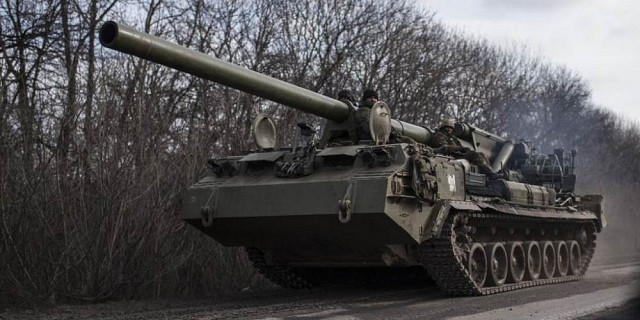
2S7 Pion
The tracked vehicles of the S-300V are somewhat similar to the 2S7 Pion. These use T-80 tank components and a V-84 diesel engine.