BTR-50
БТР-50
Overview

BTR-50PK
Soviet BTR-50PK on parade. Note the large roof hatches are opened.
Source: Unknown author -
© Copyright lies with original owner
Soviet Union - STZ / VTZ (series production)
SPW-50P (East German service)
"Schützenpanzerwagen 50P"
Egypt
Syria
Vietnam
East Germany
Description
Introduction
The BTR-50 is an early Cold War era armored personnel carrier of Soviet origin. The BTR-50 was developed for mechanized formations and was also to be amphibious. Several competing designs were tested, but the Obyekt 750 was selected due to its commonality with the PT-76 amphibious light tank which entered production 2 years before the BTR-50.
Design
The BTR-50 is an armored personnel carrier derived from the chassis of the PT-76 amphibious light tank. Instead of a turret it features a large center superstructure that houses the crew and passengers. The rear mounted engine leaves no other options for the passengers to disembark but via the roof. The roof was open on the original BTR-50P, but changed to a closed roof on the BTR-50PK.
Firepower
Standard armament for the BTR-50P and PK was the 7.62mm SG-43 / SGMB machine gun, capable of sustained fire. Prototypes were fitted with the 12.7mm DShKM heavy machine gun and the prototype BTR-50PA even had a 14.5mm KPV mounted. Neither entered service. The SGMB was replaced in 1968 with the 7.62mm PKB. Loading ramps for 57mm ZiS-2, 76.2mm ZiS-3 and 85mm D-44 field guns were often fitted. These were officially for transporting these guns in portee fashion, but during trails these guns were fired, even while afloat, with considerable success. Recoilless rifles could be carried and fired from the rear deck as well.
Protection
The initial production model had an open roof. These proved vulnerable as Soviet forces experienced during the 1956 Hungarian uprising. In urban areas these suffered from rifle fire and Molotov cocktails from the upper floors of buildings. Closed roof BTR-50's entered service from 1958. The steel armor varies from 7 to 13mm and is rated against small arms fire and shell splinters. Late during its production run NBC filters were added to the BTR-50PK.
Mobility
The BTR-50 has a good cross country performance and is fully amphibious. Ground pressure is low, which is useful in swampy terrain and in the snow. The road speed is somewhat limited with a maximum of 44 km/h. A 240hp diesel engine provides propulsion. The BTR-50PK was fitted with additional fuel tank to increase its range.
Users
The BTR-50P officially entered service in 1954 in the USSR. It was acquired in quantity for mechanized formations. BTR-50P production transitioned to the BTR-50PK with armored roof in 1958. The BTR-50PK was complimented in Soviet service with the BMP-1. Interestingly the BTR-50 was officially replaced by the BMP-2 in Soviet service. The BTR-50 was exported to several nations. It was used in quantity with Egyptian forces.
Variants

BTR-50P
Original open roof model. Entered series production in 1955, with small batches produced earlier. Derived from the PT-76 design. These open roof models were capable of carrying towed guns and recoilless rifles in portee fashion using specialized loading ramps. The original open roof BTR-50P in Soviet service were eventually exported to Soviet allies or rebuilt to BTR-50PK standard by adding an armored roof.

BTR-50PK
Closed roof model. Entered series production in 1958. Also has better amphibious performance in being less susceptible to a single large wave. Although having a closed roof it was not yet optimized for the nuclear battlefield, with NBC filters fitted during later retrofits. Automotive improvements are akin to the PT-76B. Mid production night vision for the driver was changed to TVN-2B and radio was updated to R-113. Default armament changed to the 7.62mm PKB in 1968, which also saw radio upgraded to R-123.
Details
Portee armament

BTR-50P
Artist impression of loading a 85mm D-44 divisional gun onto a BTR-50P amphibious tracked armored personnel carrier.
Source: www.btvt.info -
© Copyright lies with original owner
The BTR-50 was intended as a multi-purpose vehicle for mechanized infantry. As such it was also to be an artillery tractor for the anti-tank guns, field guns and recoilless rifle that were integral part of the mechanized formation.
These guns were towed normally on roads, but carried portee during amphibious operations. Loading ramps and mounts were fitted to load and unload these guns. The ramps extended into the crew compartment with the trails mounted on the engine deck.
Doctrine was for these guns to be transported only. During trials these were fire on land and afloat, which functioned well enough for emergency purposes.
With the introduction of the BTR-50PK and its armored roof this practice mostly fell out of favor. Introduction of the anti-tank guided missile relegated remaining anti-tank and divisional guns to motorized infantry formations.
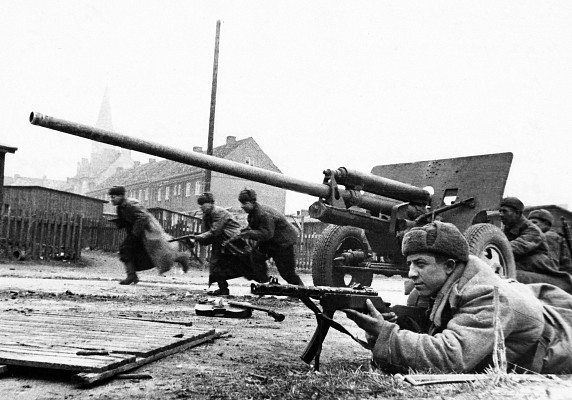
57mm ZiS-2
A 57mm towed anti-tank gun, first used during World War 2. This remained a potent weapon in the 1950's, until better armored tanks entered service. Instead of passenger the 5 men crew was carried, as well as 25 projectiles.
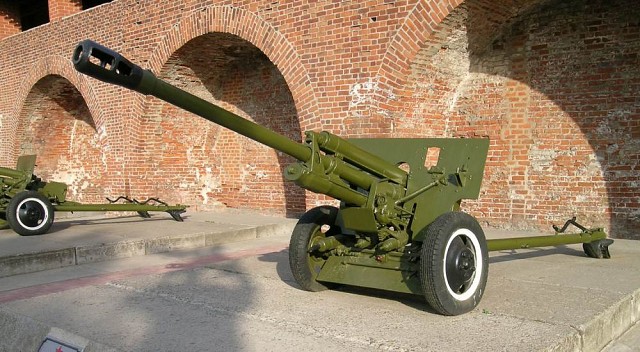
76mm ZiS-3
76.2mm divisional gun used in large numbers during World War 2. Suitable for direct fire on the battlefield and used as a light artillery piece. Instead of passenger the 5 men crew was carried, as well as 25 projectiles.
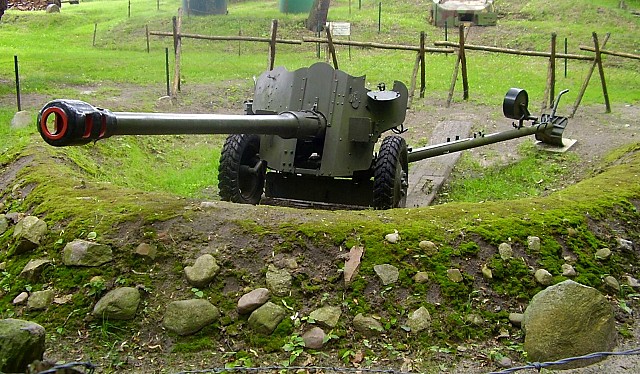
85mm D-44
Post war replacement for the ZiS-3. Its larger caliber made it more useful both against armored vehicles and as a light artillery piece. Due to its large size only 2 crew members can be carried, as wel as only a handful of shells.
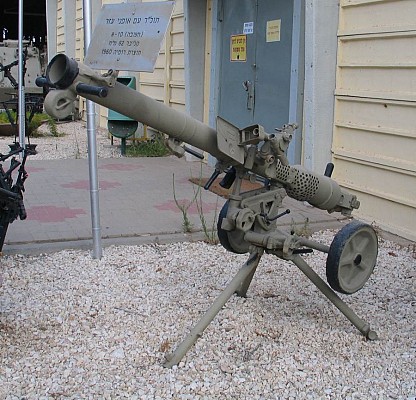
82mm B-10
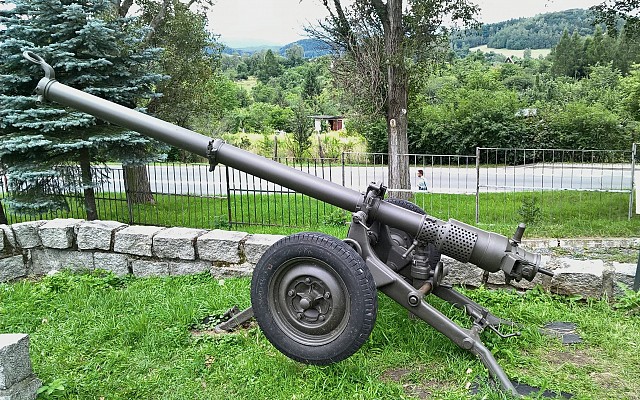
In total three 82mm B-10 could be carried including three 4 man crews and 24 shells per recoilless rifle.
107mm B-11
Only a single 107mm B-11 could be carried, including its 5 man crew and ammunition.
Media


BTR-50P
Open roof BTR-50P shown during a parade during the Cold War.
Source: Unknown author
Copyright: Copyright lies with original owner


BTR-50
Iraqi BTR-50 armored personnel carrier seen in 2004.
Source: Hamed Saber
Copyright: CC BY 2.0


BTR-50PK
Right side view of BTR-50PK of the Croatian Army seen in 2008. Note the external fuel tanks on the engine deck.
Source: Suradnik13
Copyright: CC BY-SA 4.0


BTR-50PK
Captured BTR-50PK that was pressed into Israeli service and armed with FN MAG on a new pintle mount. Now shown in a museum, photographed in 2005.
Source: Bukvoed
Copyright: CC BY 2.5


BTR-50P
Prototype Object 750 seen during trials carrying a 57mm ZiS-2 anti-tank gun in portee fashion.
Source: Unknown author
Copyright: Copyright lies with original owner


BTR-50PK
Egyptian army BTR-50PK armored personnel carrier.
Source: www.tank-afv.com
Copyright: Copyright lies with original owner
Related articles
PT-76
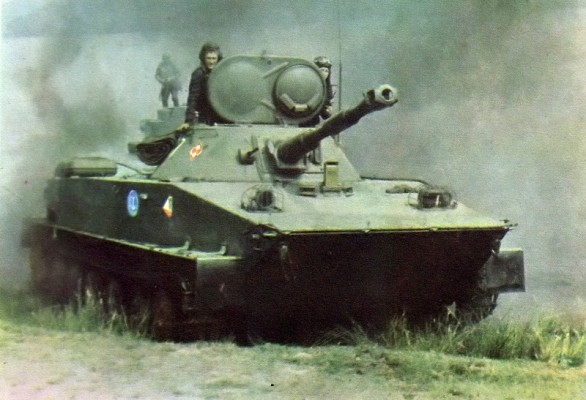
The BTR-50 was based on the tracked amphibious chassis of the PT-76 light tank.
UR-67
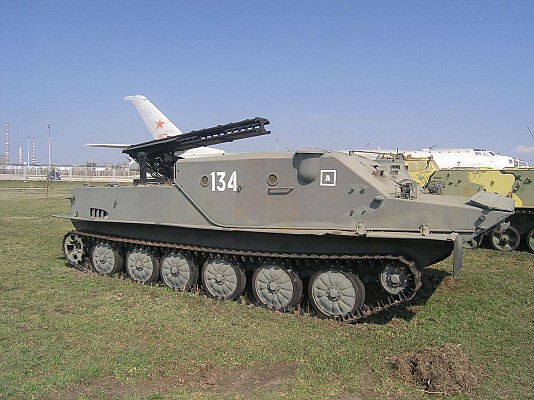
The UR-67 mine clearance vehicle is based on the chassis of the BTR-50PK.
BMP-1
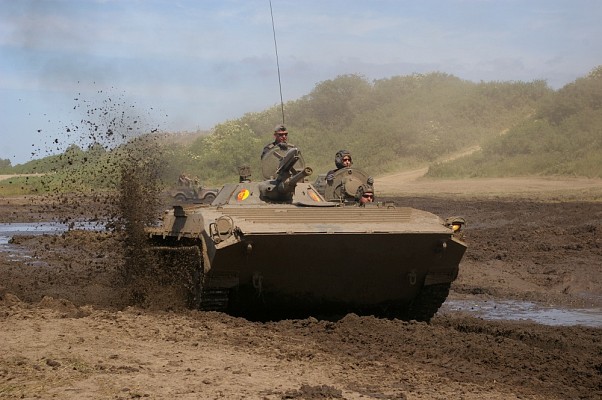
The BMP-1 supplemented the BTR-50 in Soviet mechanized formations and quickly became the preferred choice. BMP-1 has much better armament and the crew can safely exit the vehicle from the rear doors.
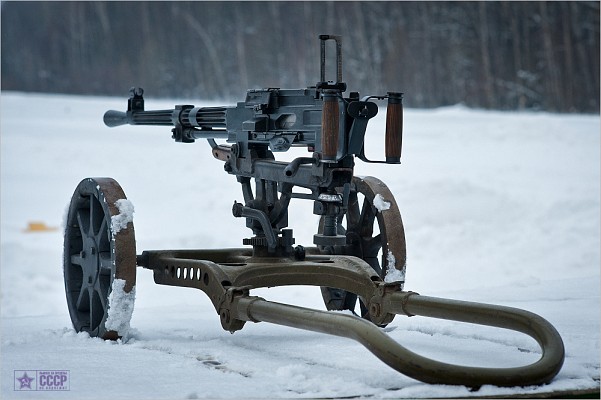
Goryunov SG-43
The 7.62mm SGMB machine gun was the standard armament of the BTR-50P and PK.