Crotale
Overview

Crotale
Crotale launch vehicle in firing position.
Source: Unknown author -
© Copyright lies with original owner
France - Matra (missile)
France - Hotchkiss (vehicles)
South Africa
Saudi Arabia
Pakistan
Description
Introduction
The Crotale is a late Cold War era self-propelled SAM system of French origin. It was developed in the late 1960's following a South African requirement. Crotale is French for 'rattlesnake'. In South African service it was known as the Cactus. China made a near direct copy known as the HQ-7 based of an evaluation system sold by the French.
Design
The Crotale system uses semi-active radar homing missiles fired from launch vehicles that have four missiles ready to fire. Two or three launch vehicles are fed target information from a target acquisition vehicle using a search radar. Both types of vehicle are based on the P4R chassis. This four wheeled chassis uses a petrol engine to generate electricity. This is fed to an electric motor for each of the four wheels. The Crotale system must be set up before it is fully operational. This means lowering three hydraulic jacks per vehicle and connecting the launch vehicles to the radar vehicle using cables with a maximum length of 0.8 km. From the Crotale 4000 system onward a VHF datalink is used.
Firepower
The Crotale missile has a solid propellant rocket motor which propels the missile to a maximum speed of Mach 2.3. Minimum range is 0.5 km and maximum range is 8 to 10 km depending on type of fire control radar used. Minimum altitude is 15 meters, with the maximum being about 5 to 6 km. The R440 missile has a high explosive fragmentation warhead with infrared proximity fuse and secondary impact fuse. Lethal radius is about 8 m.
Mobility
The Crotale system is based on the wheel P4R vehicles. These are electric drive vehicles with air suspension. A petrol engine is used to power an alternator for the electric motors. For use in the desert a diesel engine was offered. Later upgrades included an auxiliary power unit to operate the vehicles without using the main engine. Maximum road speed is 70 km/h.
Fire control
The Crotale system has all-weather capability. The Mirador IV target acquisition radar has a search radar with 18.5 km reach. Up to 12 targets can be tracked at the same time, while monitoring a total of 30. Target data is fed to the launch vehicles. The R440 missiles are semi-active radar homing. The target is illuminated by the Castor 2 fire control radar located between the missiles. Two missiles launched only seconds after each other can be guided towards a single target per launch vehicle. A TV camera allows for manual tracking of a target, allowing the Crotale to operated in passive mode until launch. This was later updated with automated tracking of aerial targets and later included a secondary infrared camera. The Crotale needs to be set up for maximum effectiveness and radar target acquisition. In an emergency a launch vehicle may fire a missile relatively quickly after coming to a halt using the optical fire control system.
Protection
The P4R vehicles feature an armor thickness of 3 to 5 mm. This may stop the lightest of small arms fire and smaller shrapnel, but otherwise provides limited protection. It is unclear if NBC protection is present, but it likely isn't. The fact that Crotale is a rather mobile system helps in survivability, especially the Crotale 4000 with its digital data link is faster to set up or move. Crotale may operate in a passive mode to avoid detection or acquisition by anti-radiation missiles. When firing the target may be tracked by optical sensors, the semi-active radar homing still requires illumination of the target during flight.
Users
The Crotale was developed for a South African requirement and South Africa was the first to adopt the system. Known locally as the Cactus. The French air force acquired the Crotale, with the army opting for the Franco-German Roland system. Crotale systems were sold to various nations until the 1990's, when the modernized and more capable Crotale NG became the new offering. Some countries still operate the original Crotale, although it has been replaced by newer systems in many nations.
System composition

P4R launch vehicle
Launch vehicle with four missiles ready to launch and equipped with a fire control radar. These carry a cable of 800 m for connection to the radar vehicle. From the 4.000 series onward the cable was replaced by a 3 km radio connection.

P4R radar vehicle
Based on a similar wheeled chassis as the launch vehicle, the radar vehicle is issued as one vehicle per two or three launch vehicles. The radar is a Mirador IV pulse doppler radar rotating at 60 rpm. This has a maximum range of 18.5 km.

R-440 missile
The R-440 missile uses radar command guidance. It is fitted with an infrared proximity fuse with back-up impact fuse. The 15 kg HE-Frag warhead has an 8 m lethal radius.
Details
Variants

Crotale
South African Cactus launch vehicle in position. Note the radar vehicle in the background.
Source: Unknown author -
© Copyright lies with original owner
List of Crotale variants
Crotale family of systems
Note: incomplete list
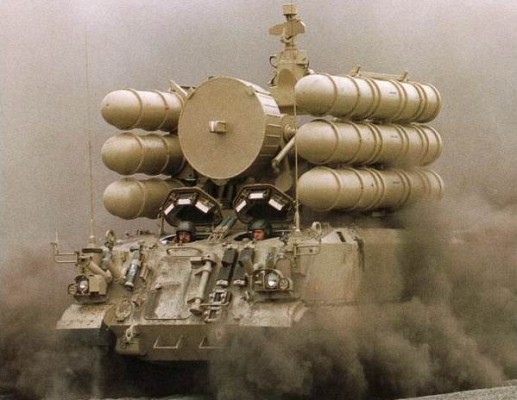
Shahine
The Shahine is an expanded capability version of the Crotale developed for Saudi Arabia. The technology is similar with the R460 being an upscaled R440 missile. The Shahine is mounted on the AMX-30 tank chassis.
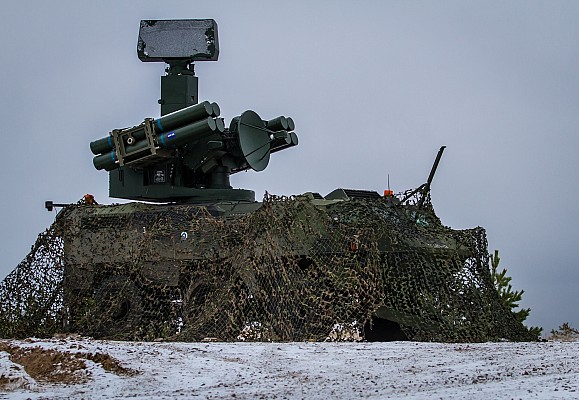
ItO 90
Finnish variant of the Crotale NG system. Mounted on a XA-181 6x6 armored personnel carrier.
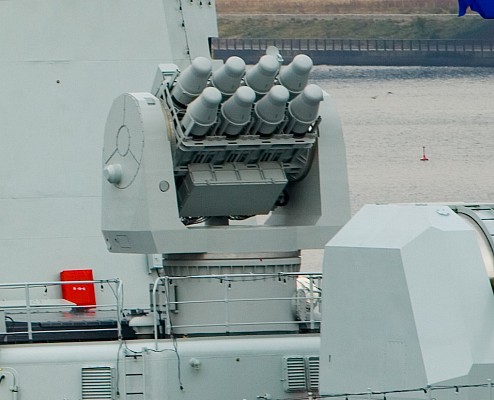
HHQ-7
Chinese derivative of the Crotale Naval. The fire control systems are separate from the octuple launcher.
Media


Crotale
Three French air force Crotale launch vehicles seen on parade in 2003
Source: David Monniaux
Copyright: CC BY-SA 1.0


Crotale
French air force Crotale launch vehicle seen on the move in the early 1990's.
Source: military-today.com
Copyright: Copyright lies with original owner


Crotale
Chilean Crotale 3000 system, consisting of two launch vehicles and one radar system.
Source: Unknown author
Copyright: Copyright lies with original owner


Crotale
Bahraini Crotale system consisting of two launch vehicles and one radar system.
Source: Unknown author
Copyright: Copyright lies with original owner


Crotale 5000
Frontal view of a French air force launch vehicle of the Crotale 5000 system on public display in 2008.
Source: Duch.seb
Copyright: CC BY-SA 3.0


Crotale 5000
Frontal view of a French air force radar vehicle of the Crotale 5000 system on public display in 2008.
Source: Duch.seb
Copyright: CC BY-SA 4.0


Crotale 5000
Rear view of a French air force radar vehicle of the Crotale 5000 system on public display in 2008.
Source: Duch.seb
Copyright: CC BY-SA 4.0


Crotale
Frontal view of a Crotale 5000 radar vehicle in desert camouflage in the field.
Source: Unknown author
Copyright: Copyright lies with original owner


Crotale
French air force Crotale launch vehicle with suspension lowered.
Source: Unknown author
Copyright: Copyright lies with original owner
Related articles
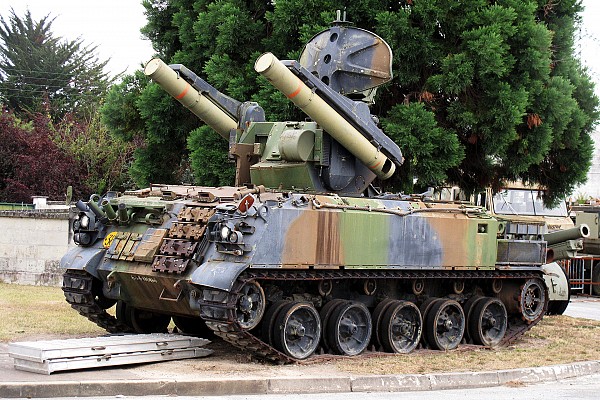
AMX-30 Roland
The French army adopted the Roland system on the AMX-30 chassis instead of the Crotale.