PTRS-41
Overview
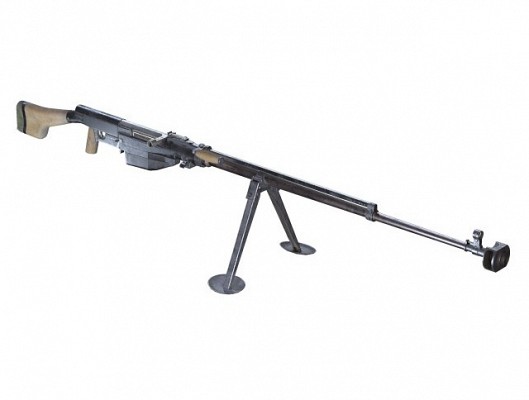
PTRS-41
Oblique view of a Soviet PTRS-41 semi-automatic anti-materiel rifle.
Source: HeroesInfantry -
© CC BY-SA 4.0
S.G. Simonov
87.187 pcs, December 1941 - June 1944
Soviet Union - No. 74 plant, Izhevsk
14.224 pcs, December 1941 - July 1942
Soviet Union - No. 622 plant, Izhevsk
77.151 pcs, July 1942 - December 1944
Description
Introduction
The PTRS-41 is a World War 2 era anti-materiel rifle of Soviet origin. It was developed by Sergei Simonov in response to a 1941 requirement. It was developed in competition with the simpler PTRD-41. Both weapon were adopted and produced at the same time.
Design
The PTRS-41 is a semi-automatic weapon that is gas operated. It uses a short stroke gas piston, has a tilting bolt and locks open when the gun is empty. It has a fixed internal magazine and is reloaded using 5 round clips. It is operated by a crew of two. Compared to the PTRD-41 the PTRS-41 had the benefit of semi-automatic fire. This came at the expense of being 5 kg heavier, being more costly to produce and more prone to failure in extremely low temperatures.
Firepower
The PTRS-41 fires the 14.5x114mm round from a 5 round internal magazine. It is a semi-automatic rifle with a practical rate of fire of 15 rpm. The sights go up to 1.5 km distance. Practical effective range was within 500 meters. Using the BS-41 projectile armor penetration is 40 mm at 100 meters.
Users
The PTRS-41 was used in large numbers by the Soviet Union with nearly 200.000 produced. It entered service later than the PTRD-41 and production numbers never caught up. However, its use on the Eastern Front was prolific. Germany adopted the Schürzen applique armor panels on its tanks and assault guns to protect the thinner side armor from the abundance of Soviet 14.5mm anti-materiel rifles. The PTRS-41 was also used in several Cold War conflicts, such as the Korean war.
Details
Related articles
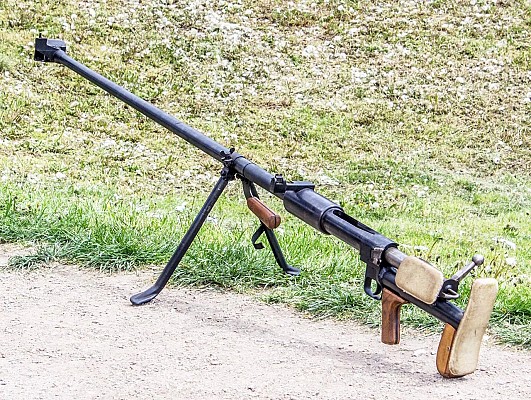
PTRD-41
The PTRS-41 was developed in competition with the lighter and simpler manually loaded PTRD-41. Both rifles were adopted and produced at the same time.
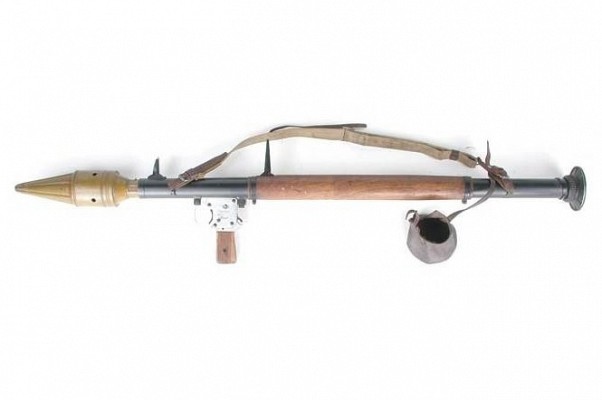
RPG-2
In Soviet service the PTRS-41 was officially replaced by the RPG-2 rocket launcher in the 1950's.